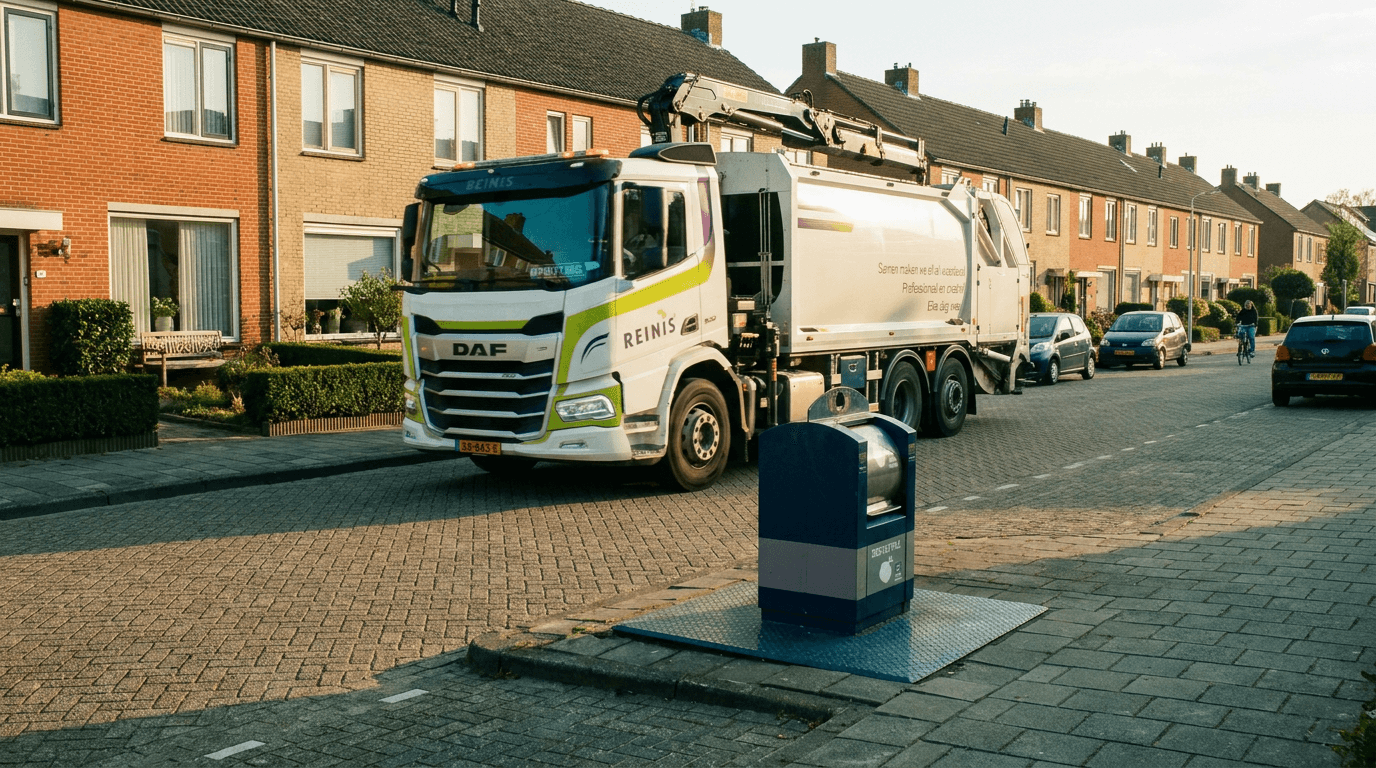
case · reinis × municipality of nissewaard

fully rolled out at reinis.
every container, every trip.

"the friday-afternoon complaints inbox used to be my week.i opened it twice last month. that's the change i notice."
edwin bijker
managing director reinis n.v.
−0%
kilometres driven
−0%
co₂ emissions
0
overflows since go-live
−0%
side-placement reports
context

one municipality, one collector,
one data infrastructure.

before we get into what changed: the triangle scoop landed in. not a pilot in a vacuum, a live operation that runs 365 days a year, with crews who've known each other for years.

reinis n.v.
publicly-owned waste collector for nissewaard. three depots (spijkenisse, hoogvliet, heenvliet), ~140 employees, 12 trucks.
municipality of nissewaard
~87,000 residents. spijkenisse plus seven village cores (geervliet, heenvliet, zuidland, abbenbroek, simonshaven, hekelingen, biert). ~960 public containers.
scope of the rollout
underground and overground, residual + plastic/metal/cartons. three crews, every working day. fully live since q3 2025, every container, every trip.
approach · 18 months

not all at once.
in phases, with a safety net.

at reinis we never start with a big bang. first two districts, first advisory mode, first planners learning along. only when the numbers add up, and only then, do we move to fully dynamic. this is what the eighteen months actually looked like.

before scoop

planning was a weekly ritual. same routes every monday, same complaints every thursday. side-placements always peaked in central spijkenisse, but nobody saw it before friday. half-empty bins in the village cores, overflowing bins in the new-build streets. no data, only experience, and experience shifted every summer and every christmas.

first week after go-live

one container on hekelingsedijk was full every tuesday at 14:00, for decades, never noticed. that bin went from 1× / 2 weeks to 2× / week. a container in the village core moved the other way: from weekly to monthly. same resources, different cadence.

month 3, spijkenisse-zuid

a driver was running the same loop every wednesday, averaging 38% fill per bin. that's 20 km of detour for about 40 kg of waste. now he drives on signal only. not less work, less wasted work.

phasing · 18 months
q2 2024selection & preparation
two pilot districts chosen: spijkenisse-centrum and de akkers. baseline measured on the existing fixed routes.
q3 2024sensor rollout district 1
new waste sensors rolled into both underground and above-ground containers. first 15-minute measurements in.
q4 2024district 2 + planner training
expansion to de akkers. scoop runs in advisory mode alongside the fixed route. planners learn pattern recognition.
q1–q2 2025wms integration & driver app
integration with the existing route-planning system. drivers receive ipads. first dynamic routes live.
q3 2025full rollout
all districts, all crews, all trucks. fixed routes remain available as a safety net, but are no longer used.
tech & integration

what's under the hood ,
and what can be switched off.

reinis already had sensors, a route planner and established processes. scoop joined them, it didn't replace them. this is the stack running at reinis, including the buttons to switch it back off.

sensors
new waste
~960 new waste sensors across underground and above-ground containers. ultrasonic fill-level measurement.
connectivity
nb-iot · kpn
99.4% uptime since go-live. in case of network drop: local buffer of 24 hours.
measurement interval
every 15 min
real-time throughput to the scoop platform. retrained overnight on the latest 24 hours.
wms integration
rest api, bi-directional
integration with reinis' existing route planner. no rip-and-replace.
fallback
fixed route, one button
on sensor failure: historical average + alert after 48h. on platform outage: instantly back to the fixed route.
privacy
no personal data
only container id + fill level. dpia signed with the municipality of nissewaard q2 2024.
before and after · reinis × nissewaard

same city, same bins,
same drivers. different numbers.

this isn't an estimate. these are the numbers reinis measured in the first 12 months after go-live, compared with the year before. the setup is unchanged, the ai makes the difference.

−0%
kilometres per day
−0%
side-placements / month
−0%
co₂ emissions
0
overflows since go-live
metricbefore scoopafter scoopdelta
kilometres per day142 km98 km−28%
stops per day137−46%
drive time per day~320 min~220 min−31%
side-placements / month~180~68−62%
overflows since go-live~15 / month00 since 2025
co₂ emissions100%59%−41%
figures from the internal reporting system of reinis n.v. · period: april 2025 – march 2026 · compared with calendar year 2024.
three voices · one rollout

what do the people
who work with it say?

managing director
we cut the monday planning meeting from ninety minutes to thirty. nobody put that on a roadmap. it just stopped being needed.
edwin bijker
managing director of reinis, guiding the rollout from day one.
planner
spijkenisse-zuid used to be the route i redrew by hand every monday. i haven't touched it since november.
rafal
planner at reinis, responsible for route planning in nissewaard.
driver
there's a container on hekelingsedijk i used to stop at twice a month for nothing. now i only stop when it actually needs me.
aniel
driver at reinis.
plan a demo

let us show you the kilometres
you'll save.

a 30-minute live demo on your own district data. we bring a planner and a driver back-seat.

rotterdam · nl